

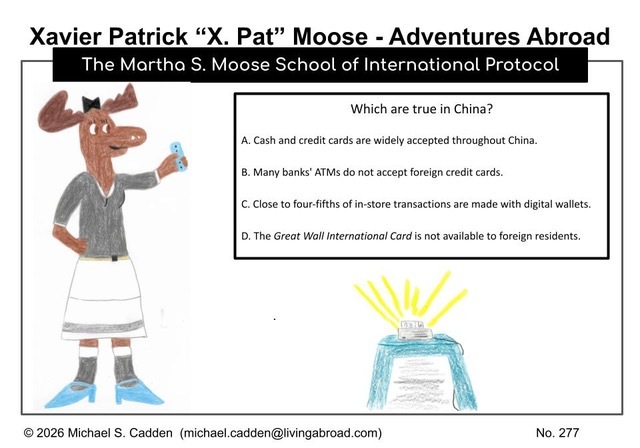
Answers: B &C
Excerpted from Living Abroad's International Relocation Center Report on China: Purchases and Bills (Finance)
Making purchases
Mobile payment platforms like WeChat and Alipay are used for the vast majority of purchases in China. Close to four-fifths of in-store transactions are made with digital wallets.
Cash, once the most common payment method, is less used today. However, be prepared to use it in some situations, and have plenty of small denominations to avoid waiting for change.
Credit card use is low in China relative to other countries. The Chinese leapfrogged the credit card phase of personal finance and directly embraced mobile app culture. While merchants in large cities and in tourist areas are also likely to accept internationally-issued physical cards, newcomers are may be best served by linking a card to one of the mobile wallet platforms. Inquire ahead of time if you are in doubt.
Personal checks are rarely used, and third-party checks, such as government checks or alimony payments, cannot be cashed.
Most retail purchases are subject to a 13% VAT. Transportation, postal services, and books and other media are among the items taxed at nine percent.
ATMs
ATMs are numerous in China and they operate on international networks, but newcomers should be aware of a few things. First is to find instructions in your language. ATMs located in Bank of China branches are likely to have both Chinese and English language options.
Many banks' ATMs do not accept foreign credit cards, so look for signage that lists accepted cards.
When withdrawing RMB from a local ATM from an account that is kept in your home-country currency, the exchange rate is typically favorable. There is a transaction fee that might be comparable to the charge you incur when using another bank's ATM at home. Check with your bank about any withdrawal limits. Also note that the ATM will have a daily withdrawal max.
You can also use certain credit cards to withdraw local currency. If you think you may want to use this method of obtaining cash, check with your home bank, before you leave, for any special requirements – such as whether you need a different PIN, whether any additional fees apply, and whether you must use only specified ATM networks, and if so which ones.
Until you are comfortable using a Chinese ATM, it is useful to choose one attached to an open bank. If you run into any issues, the bank personnel can assist immediately. Take all the usual safeguards to protect your PIN and your cash as you make your transaction and when leaving the area.
Credit and debit cards
Credit cards
Acceptance of credit cards is not universal in China, although card use is growing. Major hotels, restaurants, and stores in larger cities and tourist areas generally accept internationally known cards. However, for most other daily transactions, mobile payments or cash are used.
Major international credit cards are valid in major provincial cities in certain designated establishments. For example, their acceptance in Beijing has increased.
You may obtain cash using a major credit card at several banks in China.
China's main card (credit or debit), called the Great Wall International Card, is available to foreign residents. Interest rates and grace periods vary. The card is accepted thousands of places around China, and may be used for cash advances – although the transaction fee can be relatively high. The card is also accepted in around the world at millions of merchant locations.
Debit cards
Debit cards have traditionally been much more widely used by Chinese than credit cards. By far the most-used type of card in China, debit cards have been used to obtain cash more often than to make purchases.
Smart cards and mobile payments
Smart cards in China have been mainly used for transportation purposes and with some payroll applications, rather than purely financial transactions.
In major cities such as Shanghai, Guangzhou and Shenzhen, smart card technology is used daily by commuters. However, physical cards are being replaced by QR codes and mobile wallets in many places. Alipay and WeChat Pay are the predominant payment method around the country, accepted nearly everywhere.
QR codes
The rise of social media use – particularly the ubiquitous WeChat – has brought this transaction method to online China, and to most merchants there as well. Smartphone apps for banks, services, or retail chains typically contain a QR code, allowing the user to pay for an item or service by presenting the phone to a cashier to scan. Users can also point their own readers at other QR codes to direct payment. QR code and smartphone app users should be aware that there is potential for fraudulent or malware-installing QR codes, and use caution with this payment method.
This type of payment is used for everything from road tolls and cab rides to transferring funds to pay others or split a restaurant tab.
Paying bills
Apartment buildings and villa complexes often have an accounting office where utility bills are paid. Bills may also be paid online, at the bank, at some convenience stores or kiosks, or using a payment app if the supplier accepts this method.
Electricity may be bought via a prepaid smart card; usage is tracked by State Grid and the payment card may be attached to a mobile payment platform. Alipay and WeChat Pay have 'State Grid' options for in-app bill payment.
Depending on landlord preference, rents are paid in cash, by bank transfer to the landlord's account, or with a mobile wallet like Alipay or WeChat Pay.
Written by Michael Cadden, SGMS-T, VP International Operations