

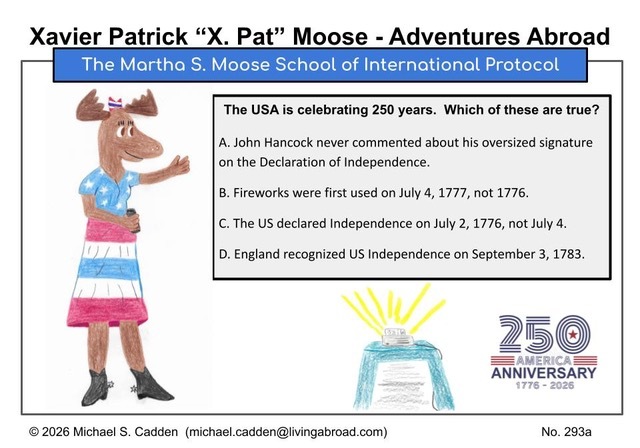
Answers: All are true
Four Myths (and Surprises) About American Independence Day
A. John Hancock never commented about his oversized signature on the Declaration of Independence.
Everyone knows John Hancock's signature, but probably not for the reason they think.
Congress ordered a parchment copy of the Declaration of Independence on July 19, 1776. On August 2, the delegates gathered to sign the official copy. According to the National Archives, John Hancock, as President of Congress, signed first, placing his bold signature front and center beneath the text.
We've all heard the story that Hancock signed his name extra large so King George III could read it without his spectacles. It's a great story...but there's no evidence he ever said that. In fact, if you look at other documents he signed, you'll see that writing his name in large, sweeping letters was simply his style. And to this very day adding your "John Hancock" means adding your signature.
Forty-nine delegates signed that day, and seven more added their names later, bringing the grand total to 56 signers.
B. Fireworks were first used on July 4, 1777, not 1776.
It's hard to imagine the Fourth of July without fireworks, but they weren't part of the celebration in 1776.
The first organized Independence Day fireworks took place on July 4, 1777, exactly one year after the Declaration was adopted. So, while fireworks now feel as American as apple pie, they actually arrived fashionably late to the party.
C. The US declared Independence on July 2, 1776, not July 4.
Here's one that surprises almost everyone.
The colonies actually voted to become independent on July 2, 1776, when the Second Continental Congress approved the Lee Resolution, officially declaring the colonies to be "free and independent States."
So why do we celebrate on July 4? Because that's the day Congress approved the final wording of the Declaration of Independence—the document that explained why the colonies were breaking away from Britain.
Even John Adams thought July 2 would become the nation's great annual celebration. History had other plans.
D. England recognized US Independence on September 3, 1783.
Declaring independence and having it recognized by your former ruler are two very different things.
It wasn't until September 3, 1783, that Great Britain formally recognized the United States as a free and independent nation by signing the Treaty of Paris. The treaty was negotiated by David Hartley for Britain and John Adams, Benjamin Franklin, and John Jay for the United States.
Besides officially ending the Revolutionary War, the treaty established the young nation's boundaries (stretching west to the Mississippi River), granted Americans valuable fishing rights off Newfoundland, and provided for the return of prisoners of war and the handling of property seized during the conflict.
In other words, America declared its independence in 1776—but it wasn't officially acknowledged by Britain until seven years later.
Sources: https://www.archives.gov/milestone-documents/treaty-of-paris
Written by Michael Cadden, SGMS-T, VP International Operations